


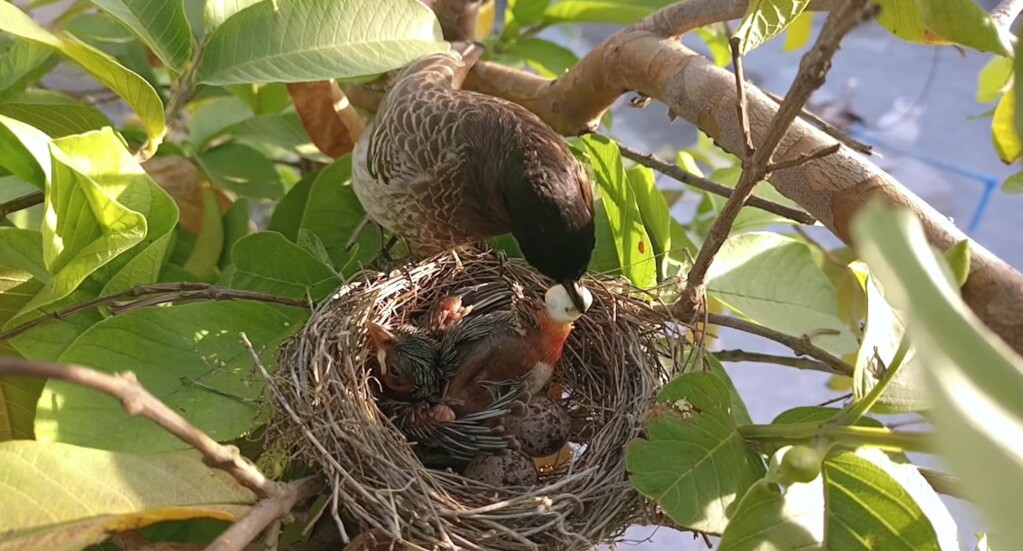
Let Mother Earth do her work
Whenever life begins to smile at me with its full radiance, I receive a quick reminder not to get too excited — things are still far from how they should be. Even a simple letter can reveal how loyalty is expected to flow one way only: I’m asked to pay unquestioningly, to prove my reliability even when the system itself fails to act with integrity.
When loyalty becomes a shield for corruption, the nest begins to rot from within. Yet nature shows a different intelligence: the mother bird who quietly removes waste from her nest, preserving life’s coherence. This article explores how truth, responsibility, and the unified field of consciousness cleanse the social and economic systems we have allowed to become parasitic — and how they can evolve toward symbiosis.
When the system soils its own roots
Last night I noticed that a debt collection agency had sent a payment reminder to my OmaPosti digital mailbox for an unpaid invoice. The letter didn’t specify which invoice it referred to, and I had never received the original bill. It mentioned that the client was the City of Helsinki, and the invoice was apparently a dental bill I had been expecting for some time.
But I certainly wasn’t expecting a bill from a collection agency, nor that the total had been padded with late fees and “notification charges.” It’s possible the city did send me a bill, but it got lost on the way. One wonders why the invoice wasn’t sent to OmaPosti or some other digital service in the first place — the same place where I found the collection agency’s reminder, now fortified with extra fees. (This doesn’t mean I recommend paying bills through OmaPosti. I once paid an invoice directly there, the money was withdrawn from my account, but the original issuer never received the payment.)
Old pattern: parasitic economy and the avoidance of responsibility
This extremely frustrating “glitch in the matrix” reminds me of an incident twenty years ago, when I received an unjustified invoice from a company I had never ordered anything from. I was abroad when the bill arrived and only saw it six months later upon returning home. By then it had gone to collections, and I had received a stack of collection notices. On top of that, I had a credit default entry, which placed me on the commercial registry’s blacklist.
Since I had never ordered anything, the original issuer had no order confirmation to justify their invoice. They voided it, but no one seemed to have the authority to void the collection agency’s unjustified fees, let alone remove my name from the blacklist. The collection agency simply stated that they had no obligation to verify the legality of their actions — meaning they didn’t need to wait for the issuer to present proof of an actual order.
The Federation of Finnish Enterprises, whose task is to ensure a healthy operating environment for entrepreneurs, felt like a mafia organization demanding protection money (membership fees) in exchange for the privilege of conducting business in peace. Creating a healthy environment is not an impossible task when there is genuine goodwill.
The Mask of the Innocent Eyewitness
These are not trivial everyday inconveniences, because the same patterns of thinking prevail at every level of society. Once I bought a branded product from an online auction, and I knew the original sizing well. When the item arrived, it didn’t fit at all — it didn’t match the brand’s sizing in any way. When I cancelled the purchase and explained the core issue, the seller gave me negative feedback, strengthened by his own interpretation that showed he hadn’t understood anything: he was selling pirate products while implying they were original brand.
The auction platform operators were likely fully aware of the scheme, since there wasn’t even an option to report the dishonest practice. After all, one must provide the offspring with opportunities to earn money.
This is how ordinary people retreat into the role of innocent bystanders, taking no responsibility for the consequences of their actions. When they make the recipient of their services feel more like prey, there is nothing innocent about it. The extreme example is a murderer who has pretended to be an innocent witness and “visionary” for decades, acting solely to mislead investigators so that his own guilt would not be revealed.
The illusion of individual freedom
Our so‑called democracy emphasizes individual freedom, but individual freedom only exists within a community governed by common sense. The clearest example is what we eat. Our freedom is limited to choosing the least bad option among bad ones. One can only guess how many illnesses and allergies are caused by artificial fertilizers and the additives pumped into our food by the food industry. Yet doctors often speak as if the problem lies in the food itself.
Years ago I watched reality shows where people weighing over 300 kilos struggled with weight loss. Often they underwent gastric bypass surgery, after which they were simply expected to eat less. For many this worked, when they were mentally committed to reaching normal weight. For others the results were nonexistent, and after the initial enthusiasm the show began to feel like an uncomfortable guilt session.
To me it was obvious that under normal circumstances no one can eat themselves to death — which was the immediate threat for these 300‑kilo individuals. Their problem was that they mostly ate ultra‑processed food designed to create addiction. I have personal experience of this: when I got a capsule coffee machine, I began mixing vanilla ice cream into my coffee.
Last spring this habit had become almost compulsive, and when ice cream consumption reached four liters a month, I thought it would be cheaper to make ice cream at home. And so we did. After a week or two of homemade ice cream, my addiction disappeared. The ice cream tasted just as good, but without the compulsive need to “reward” myself.
A similar disappearance of cravings happened after my cancer surgery in 2020. Before the surgery I always wanted cookies with my coffee. It felt strange, because I normally didn’t have such cravings. After the surgery I didn’t even look toward the cookie shelves. I assumed this was because the craving had originally come from the cancer cells’ need for carbohydrates and sugar.
The misuse of loyalty
Our freedom at the individual level only manifests in relation to the community we live in. Often people who emphasize their individuality and the freedom of their reference group demand secrecy from their inner circle, friends, and group members — invoking loyalty when their corrupt practices and crimes are at risk of being exposed. They think that truth‑tellers who reveal harmful practices and crimes within their circle are “shitting in their own nest.”
The metabolism of truth
But we must recognize that the only thing deserving our loyalty is truth — truth that considers the whole and expresses common sense. People who operate under corrupt practices, hiding their crimes, have themselves “soiled their nest,” because ultimately it is simply the obstruction of the community’s metabolism — the free circulation of energy. To reveal the truth, the intellectual unified field operates just as precisely as when it exposes a murderer who has played the innocent witness for decades through DNA evidence.
Parasitic Structures and the Possibility of Symbiosis
Human beings’ corrupted practices are usually parasitic structures that disregard individual freedom. And when societal systems are not designed from the perspective of freedom, they become constricting. I am not saying that parasitic actors or systems are unnatural. In nature they are visible to everyone, and they usually have a purpose. Yet from the standpoint of fruitful cooperation they are problematic, because our aim is to increase our mutual freedom and share our abundance so that we can rejoice in each other’s presence.
Despite all the contradictions and friction present in human systems, decision makers generally want things to work and to serve people. I have seen this again and again. When I wrote my feedback Reflections Stirred by the Madness of the Assistant Business, the chaos in assistant services became visible — not only through my words, but through the feedback of many others. Soon after, the company providing the assistant services I used ceased to exist, and the home‑care company lost its contract with the city as well as a significant portion of its customers. I was not the only one pointing out what was wrong; the unified field simply responded when enough people illuminated the friction.
I continued with the same home‑care company, because the chaos I experienced is a learning opportunity for all parties involved. Learning opportunities should not be avoided. Disorder becomes problematic only when people refuse to see what is wrong. I have witnessed this in other contexts as well — such as with my former internet operator, when those responsible did not even acknowledge the inconsistent billing data in their online service, data on the basis of which they charged me late‑payment interest. When people cannot see the discrepancy, the system cannot correct itself.
Toward Symbiosis
We live in a strange transition period. For decades, people were taught that subjective experience was unprofessional unless it was wrapped in citations and external authority. The old paradigm insisted that truth had to be borrowed — that one’s own perception was somehow insufficient unless validated by an external source.
To understand how symbiosis becomes possible, we must first understand why subjective experience has become the new foundation of coherence.
The New Authority: First‑Hand Experience
When we recognize subjective experience as the new authority, our way of relating to others changes. Systems become parasitic when we elevate external experts above our own intuitive perception — when we treat borrowed authority as more valid than lived reality. But in truth, we are all experts of our inner world. Symbiosis begins when each person stands in their own experience without demanding ownership over ideas or policing the expressions of others. When individuals trust their intuitive ground, they no longer need to extract validation from others, and the shared space becomes cooperative rather than competitive.
Subjective experience is the only first‑hand reality we have.
It is the only thing that cannot be stolen or borrowed.
It is the only thing that cannot be outsourced.
It is the only thing that arrives without distortion — until we begin interpreting it.
And yet some still demand “sources” for someone’s inner perception, or accuse others of “stealing” ideas that were never theirs to own. They behave as if human experience were a private patent, as if topics belonged to individuals rather than to the shared field of consciousness. This is how people end up shitting in their own nest — poisoning the shared space with insecurity instead of tending their own inner ground.
The Misinterpretation Loop
The only risk in subjective experience is not that it is unreliable, but that one may interpret oneself incorrectly. The error is never in the experience itself — the experience is pure.
The error lies in the narrative built around it, the story one tells about what the experience means. When the interpretation is distorted, the whole inner ecosystem becomes polluted, and people begin projecting that distortion outward.
When a person misinterprets their own experience, they begin to treat their inner narrative as objective fact. The insecurity born from that misinterpretation seeks an outlet, and it often finds one in others. They start policing ideas, demanding ownership over topics, or insisting that someone else’s expression somehow threatens their own. This is the misinterpretation loop: an inner distortion projected outward until the whole shared space becomes contaminated. Instead of tending their own perception, they try to control the perceptions of others — and in doing so, they soil the very nest they live in.
Toward Intuitive Design
When the will to create functioning systems exists, parasitic structures require only a shift in perspective. We must examine things in a way that allows different actors to form symbioses (not cartels), always taking the whole into account. This is not a privilege granted to us by decision makers or politicians, but the natural mode of operation of the intelligent unified field. In the following articles, we will explore what intuitive design looks like from the perspective of symbiosis.